

One honest thought about overcoming uncertainty in 2026 (and a small ask)
The insight that keeps coming htough this year is that Most people know what they want. The uncertainty is whether they can handle the consequences.

For anyone facing a difficult unknown in 2026, my prediction would be that it’s not the choice itself that feels like the problem; it’s the consequence of the choice.
What I mean is, most people already know what they want, or at least have a good idea of the options, and usually have a preferred outcome.
The problem, or the uncertainty, comes from a fear about whether they can handle the consequences of making that choice.
For most people, that choice is about work, home, money, health, or family, and it’s usually a trade-off between change and stability, growth and safety, or meaning and security.
But, at its core, the uncertainty isn’t confusion.
It’s the emotional cost of committing to an outcome.
Uncertainty isn’t so much about not knowing what to do, it’s about the fear of being wrong. Of not living up to the choice you want to make. Of what you’ll have to let go of if you move forward.
That’s the promise of The Uncertainty Toolkit: It won’t change your uncertainty; you can’t ‘fix’ that, but it will change your relationship with it.
It’s been shown to reduce the stress response that makes decisions feel threatening, improving clarity when you’re afraid, and increasing what psychologists call Uncertainty Tolerance. Not certainty. Tolerance.
As I write this, I’m using tools from the book, leaning into a personal uncertainty that makes me uncomfortable, and asking for a bit of help.
Week one matters disproportionately for books. Algorithms, charts, bookshops, publishers, future invitation; all of it places outsized weight on these first few days, and the book’s out TOMORROW.
If this work has ever interested you and you’ve been on the fence about buying a copy, now is the moment it will help most.
If you already got one, THANK YOU. Please sign up for the webinar we’re running in January to say thanks to all our bookbuyers and submit your challenges and questions.
Or, if you’d like to buy one, but money’s an issue, or you know someone who needs one but can’t afford one, then drop me a line.
I’ve got 14 copies on my shelf that I was probably supposed to send to influential friends (ahem) that I’ll post one of to you instead on Friday.
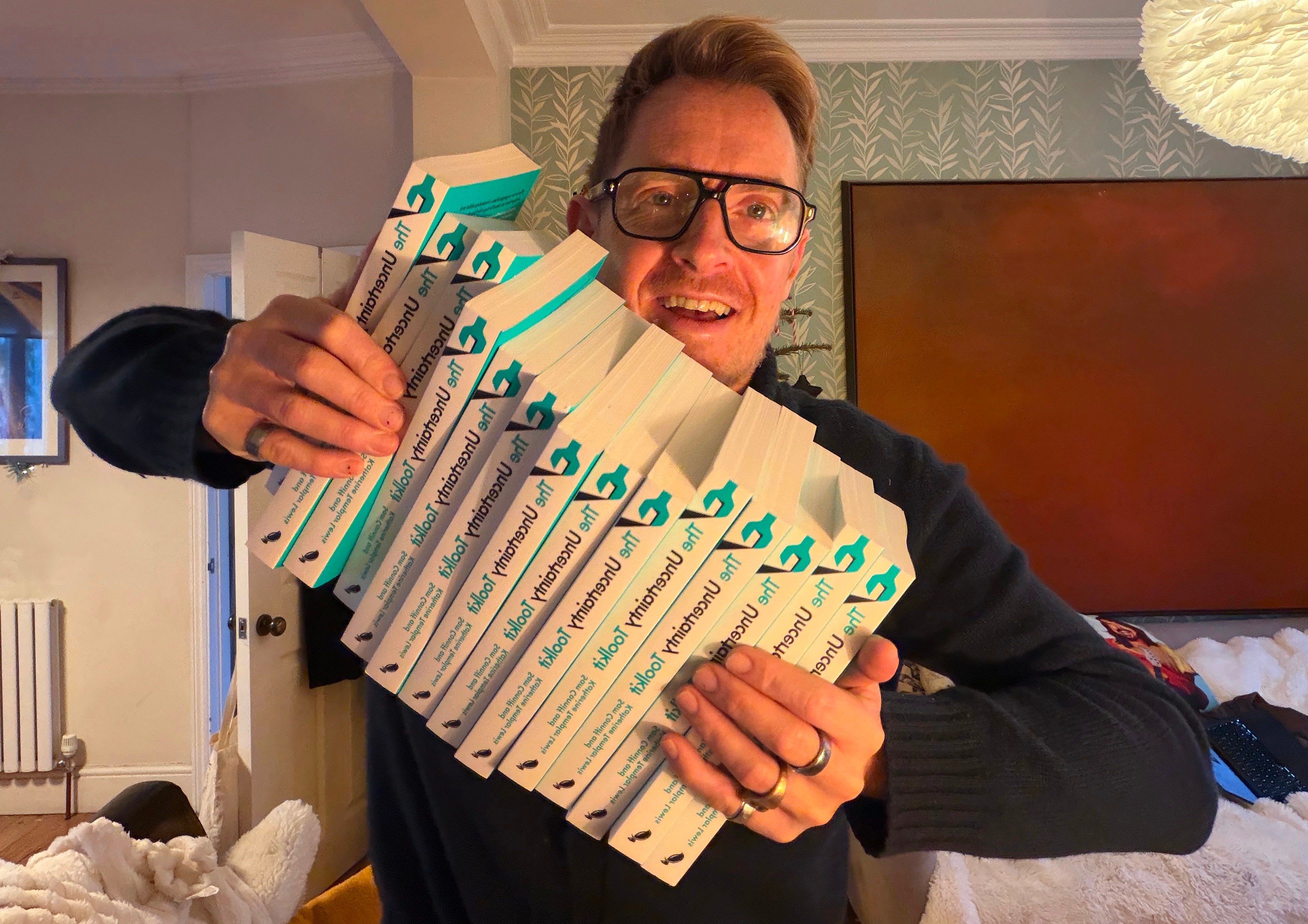
Uncertainty often hits hardest when life feels tightest, so if that’s you or someone you know, drop me a reply with the address and any details, and I’ll send it, no questions.
But, if you are buying, here are your options:
– This one goes to Amazon, who have a 20% discount on as i write this, thanks, Amazon.
– The audiobook is here and includes original audio from the Uncertainty Experts themselves, and tracks co-produced with Ross from Morcheeba.
However, next year unfolds for you, I wish you courage with the choices you already know you’re facing.
One final thought, borrowed from the end of the book:
The exhaustion so many of us feel doesn’t come from uncertainty itself, but from trying to get back to certainty. Which I think we can be sure isn’t coming back.
So, as you make your predictions and plans for the year ahead, the thought from the last chapter of the book is that I’ve seen it help hundreds of people to start thinking about a post-certainty world.
Uncertainty is unsettling; the promise of certainty is false, but post-certainty can become a generative space for creativity, positivity, and opportunity.
And that would be my wish for you and your year ahead, happy post-certainty, in 2026.
Normal rambling substacks will resume soon. Please forgive the Publication Day Eve Promotional Message.
Sam
Hello Sam,
Happy New Year. Congratulations on your book. I have signed up to your Webinars on your uncertainty expert website a while ago and also sent my receipt confirming my pre-book purchase last year. I still have not heard back from you.
Will you be communicating to us soon with regards to Webinar dates and bookings this month, January 2026 please.