

How UK Entrepreneurs beat Global Leadership teams at Netflix, Nike & Google.
Calling All Entrepreneurs To Join a Social and Psychological Experiment to Increase Uncertainty Tolerance Amongst Enterprise UK.

A pilot cohort of U.K. Entrepreneurs recently completed Uncertainty Experts backed by Stride.VC and, unsurprisingly, had the best scores for Uncertainty we’ve ever seen.
We’ve had teams from Lego, Nike, Netflix, Unilever, BBC, Nestle, NHS, and MOD. But what came next surprised us more.
Over three years, we’ve asked thousands of participants how uncertainty makes them feel. 80-85% of responses describe negative sentiments, 10% mixed and 5% positive.
However, with entrepreneurs, it shifts to 60% negative, 20 mixed and 20% positive.
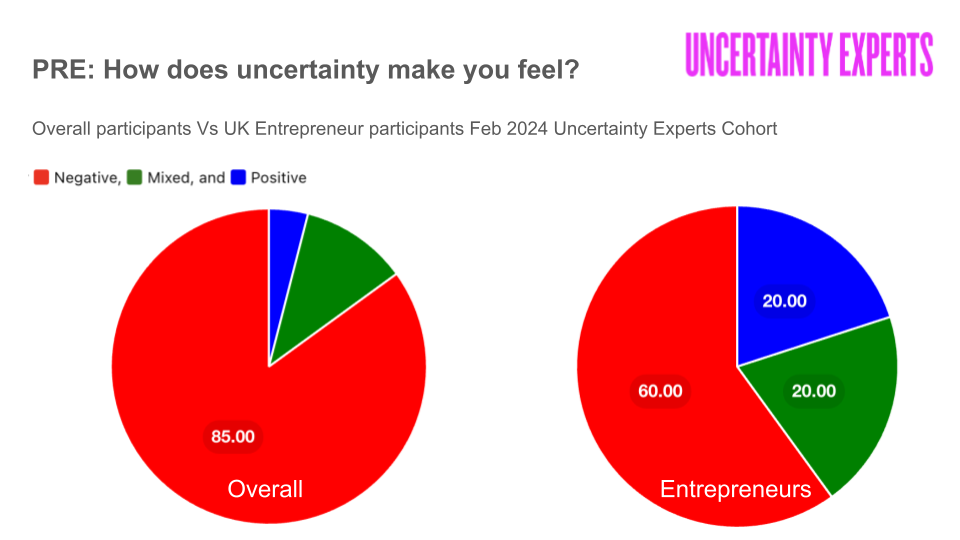
This is the least negative / most positive score of any group we’ve ever run in three years and tens of thousands of people.
It’s better than leadership teams from Netflix, Nike, The NHS, Google, the Ministry of Defence, Unilever, Nestle, Coke and many other high-performing organisations.
UK entrepreneurs outperformed them all.
So far, so good. However, it’s a modest, small sample, so it is not statistically valid, but it is potentially a promising way to support Entrepreneurship UK.
Read on to nominate or participate.
An now this, is where it gets interestingwhat’s surprising iscause it’s not therprising, but the impact it could have.
Most people don’t understand that uncertainty is the meta threat, the end-of-level baddie, the puppet master behind their daily struggles.
Uncertainty is the number one driver of anxiety; it’s why we hate public speaking, it’s why you don’t like difficult conversations, and it even helps explain the fear of clowns.
Humans’ fundamental fear is the unknown; on the whole, we’ll do anything to avoid it.
From self-medicating to doom scrolling to announcing shit backwards-looking shallow policies in an attempt to look like you’re in control of something.
Uncertainty might not be the visible symptom, but it’s usually the cause of our self-sabotaging behaviours as we desperately cling to the illusion of certainty.
How does this manifest in a way that could benefit Entrepreneurs and, therefore, the UK economy and innovation?
Well, the next set of questions reveals the types of Uncertainty the group faces and their perceptions about the potential for opportunity.
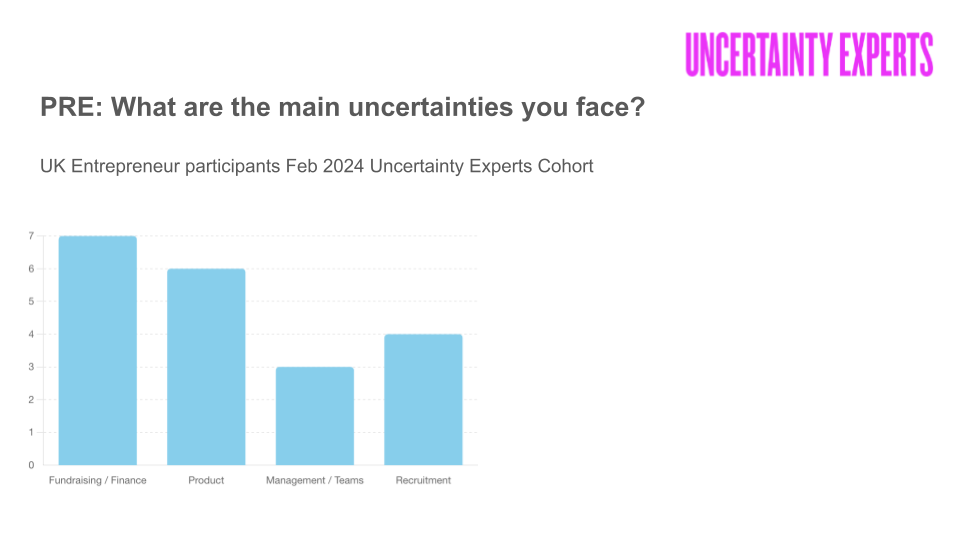
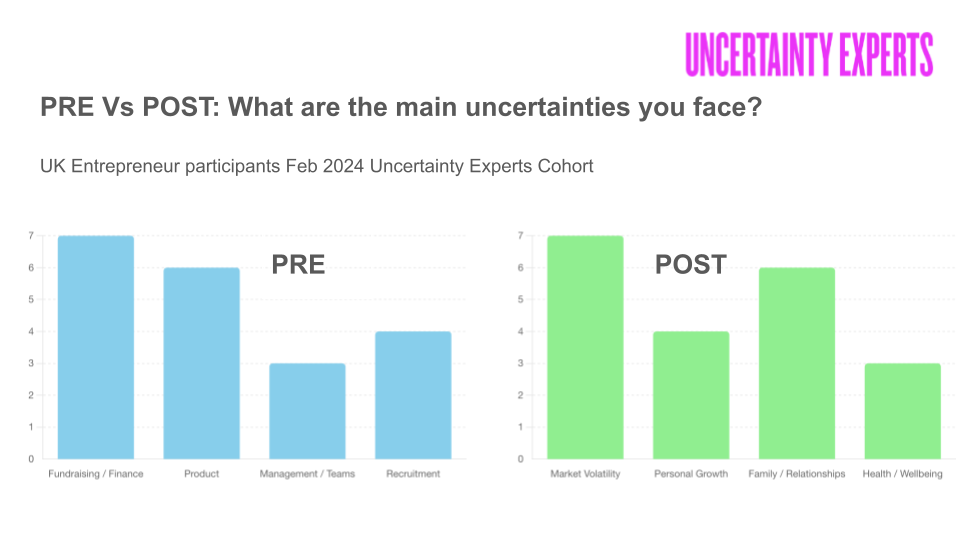
Here, we can see that before the intervention, entrhadneurs have a very narrow focus; every uncertafaced wasey face is about their This iss. So far, also unsurprising.
But compared to the general population, where the main uncertainties always fall into the same five sections (work, money, relationships, health, state of the world—in that order), the entrepreneurs' outlook suddenly doesn’t look so healthy.
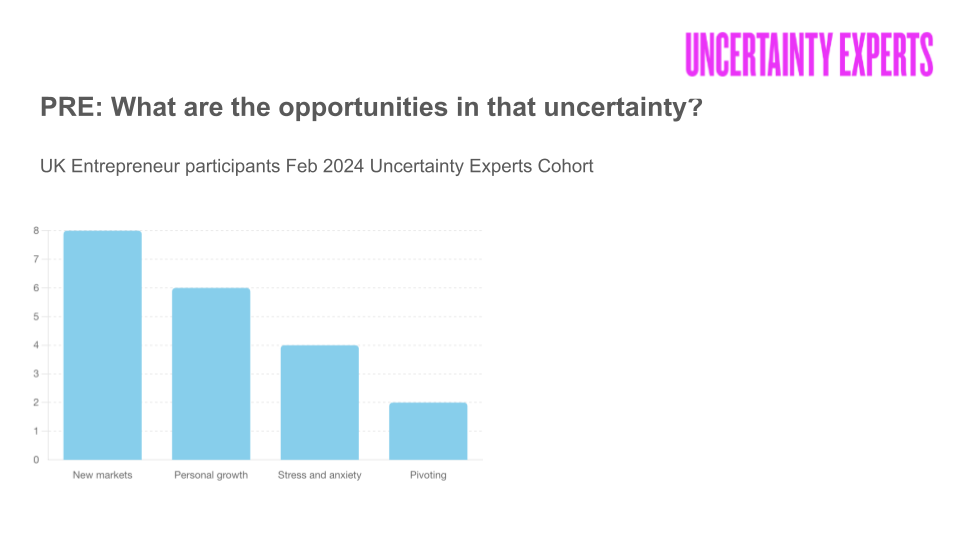
Entrepreneurs’ relationship with burnout has been well studied and is often not as bad as that of salaried workers. However, these are testing times, and with two out of three new jobs in the UK created by start-ups, support for entrepreneurs is essential.
This is where the next set of results begins to looattractiveng.
Once the pre-assessment was completed, the group participated in The Uncertainty Experts, a three-part online course and interactive documentary co-created by Netflix and University College London’s Decision Making In Uncertainty Centre.
The group then watches three one-hour episodes featuring Gang Leaders who have become Business Leaders, Smugglers Who Have Become Specialists, Refugees who have become CEOs, and people who have gone through the justice system, gender transition, and more.
These remarkable stories are interspersed with science explainers about Uncertainty Experts' cognitive tools and embodied pThe explainers turn the stories turn them into a toolkit for the viewer and provide guided reflections that integrate the learning.
After this, audiences take a second assessment of their Uncertainty Tolerance, where the shift we suspect could become so valuable that it becomes visible.
Firstly, the sentiment around uncertainty moves dramatically. While it was pretty positive before, it’s now 100% positive. There are no mixed or negative views.
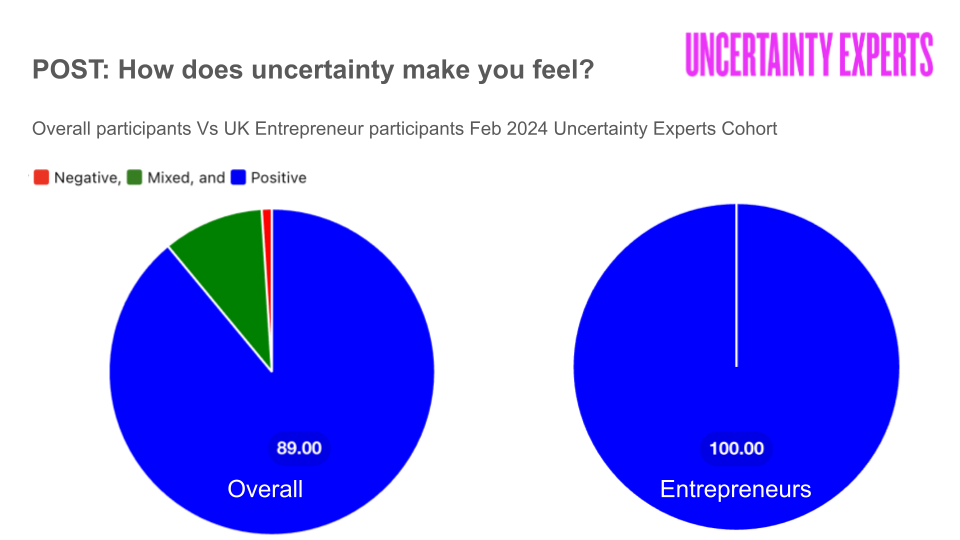
And, compared to the overall participants, the entrepreneurs are now supercharged for transforming uncertainty; it’s almost too good.
Secondly, the types of uncertainty in their consideration set have gone from intense and borderline unhealthy to balanced and broad, including relationships and health.
Lastly, the opportunity they can now see has also evolved and includes a range it’s fair to assume will lead to a more sustainable and successful entrepreneurial life.
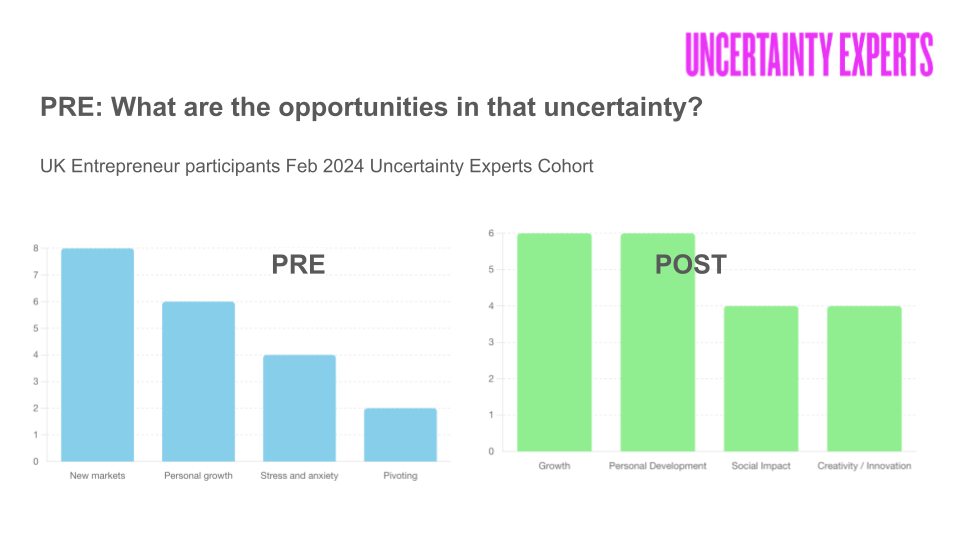
Where once they saw only opportunity for growth, stress or a pivot, it now ranges from growth to personal development to impact and innovation.
It’s an interesting sample that demands exploration. And so, we’re inviting other entrepreneurs to join our next public cohort so we can corroborate this data set.
But, for a moment, imagine if the trend did continue, what this could do for U.K. Entrepreneurs with an easy-to-scale, low-cost, entertainment-led intervention.
If the trend continues, we could create entrepreneur-specific support packages or partner with one of the UK’s start-up support networks for a robust trial.
If the evidence is maintained against control groups, we could have an easily scalable, low-cost asset that will give UK entrepreneurs a competitive edge in uncertain times.
Which, we think, is a goal worth investigating.
The next cohort begins June 4th and requires one hour a week for five weeks, plus three 10-minute psychological assessments before, after and again six weeks later.
We’ve set up a discount code for Entrepreneurs who want to participate. Use ENTREPRENEUREXPERIMENT at checkout, or go here.
All data will be anonymised, and the results will be shared with every participating entrepreneur. If successful, we’ll take the data to the umbrella bodies and support networks for entrepreneurs to see how widely available we can make it.
If you are an entrepreneur and interested, I’d LOVE for you to join us in exploring this further. Sign up here for a discounted place.
If you’re not an entrepreneur but think it’s interesting, please share it with any Founders you know or networks that might be supportive.
Like all my experiments and investigations, I’ll share updates and insights as they come.