

How do we Make politics dramatically less stupid in a single day?
My night with Wes Streeting, a soon-to-be pop-up ministry of uncertainty: And Last Orders at the Dadosphere.

Wes Streeting leaned in and conspiratorially suggested I should be Labour leader. A true tale of how woebegotten things had gotten one dark night, a few years ago.
Before you get the wrong idea, it wasn’t 3 am at Inferno’s, Wes sweating in my ear, on his second Mitsubishi, telling me to do the top job. It was (sadly) not even close. It was a workshop in a mediocre hotel in a town that might as well have been Reading, with the now-Labour front bench, trying to pin the tail on a strategy
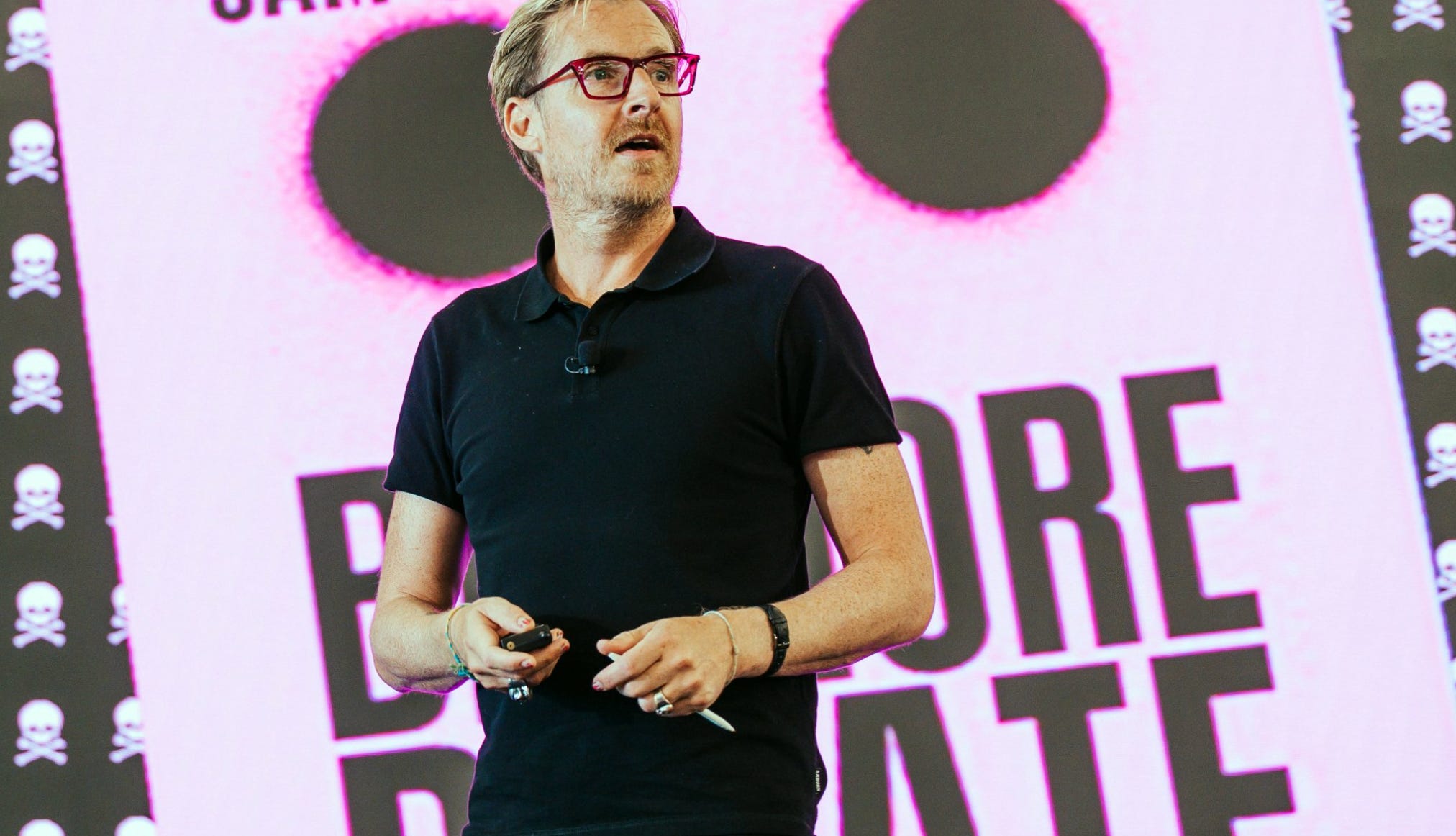
I was there as the Captain of Be More Pirate, running our breakthrough session on the true history of pirates as social revolutionaries, innovators and general inspirational badasses. It’s a history not many people know about, but if you ever need a life-changing, history-making mutiny in a team, I’m your pirate.
But I digress, in pursuit of a quick plug, back to that long night of the soul of the Labour Party, where I seemed like a good idea.
Back then, Labour’s problem was a catastrophic meltdown. Oh wait…
Anyway, for a while, I helped them pull a fractured movement together, reconnect with shared values, and stop behaving like a family argument with a press release
Which they did, enough to manage about 36 days looking like a government.
I wonder what Wes would say today if he still saw me as leadership potential (as he pulled the knife from between my shoulders) because the brief has changed. The problem is no longer unity. The problem is uncertainty.
And those who know how to work with it look like they’re winning, and those who don’t look like wallys.
The next two years are going to be an uncertainty-driven fucktastrophe (#officialterm). Leadership contests, economic meltdown, AI, climate crisis, culture war, actual war, people who push prejudice surging, people who insist they can be trusted lying, anyone admitting it’s complicated punished for nuance, and backwards-looking narratives everywhere because y’know, give us more Gladiators.
So here’s my offer. Give me ALL our politicians, teams and advisors, for a day, and we, The Uncertainty Experts, will make politics less stupid.
Not completely unstupid, but measurably less reactive, less groupthink, less likely to mistake speed for courage and saying “hard choices” whilst making no choices.
Give us the lot, even the ones who have to explain they’re definitely not racist, one day, and we’ll hand you back humans who listen, decide and debate better #sciencefact
We all have an Uncertainty Tolerance, and when it’s low, it looks like, well, politics…
A party panics borrows the language of its opponents, and calls that policy.
A leader fears looking weak, mistakes dissent for disloyalty, and calls that discipline. Advisors develop slogans so dead inside they could be a GB News presenter.
A government faces long-term structural problems and chooses short-term performative action because the next headline means more than the next generation.
That’s not leadership. That’s an identity crisis with a calendar invite.
And we can shift this, actually, measurably, meaningfully, literally, we’ve done it before, in fact, we do it all the time, with tougher crowds too. I mean it, you write to your local MP, get them along, and we can increase their ability at ambiguity.
I know I’m prone to the odd future truth and mild dose of enthusiasm, but since Uncertainty Experts was acquired by MediaZoo, I haven’t just been sprinting from client to cohort to airport sandwich to debt collection call. I’ve had the most dangerous thing possible, time to think…
For some hard evidence, here’s what we called the Decisiveness Crisis (A pretty good white paper here if you can bear another thinly veiled piece of self-promotion). Which asks the deliberately false binary: when facing uncertainty, would you rather be seen as decisive, even if that led to a negative outcome or could you tolerate being seen as indecisive, if that led to a positive outcome?
Two-thirds of teams and up to 80% of leaders choose the negative outcome.
Not because they’re stupid, bad, or want things to go wrong. But because uncertainty is cognitively expensive, emotionally demanding, socially risky, and frankly, irritating.
People prefer to sound decisive in the short term. And call the damage leadership.
But the useful bit isn’t about decisive versus indecisive. It’s about people trying to create the best possible future and end the discomfort of not knowing. One is leadership. The other is relief.
So I went back into the data. What separates those who can tolerate uncertainty to find a better outcome? I assumed it would be: age, gender, seniority, ego, baldness.
It was none of them. The difference emerged not from people’s past, but in how they saw the future: What’s the uncertainty? What’s the opportunity? What’s stopping you?
And honestly, I got out of bed when I had that thought and came downstairs to rerun the data because A) that’s how exciting this is, and B) how sad I’ve become.
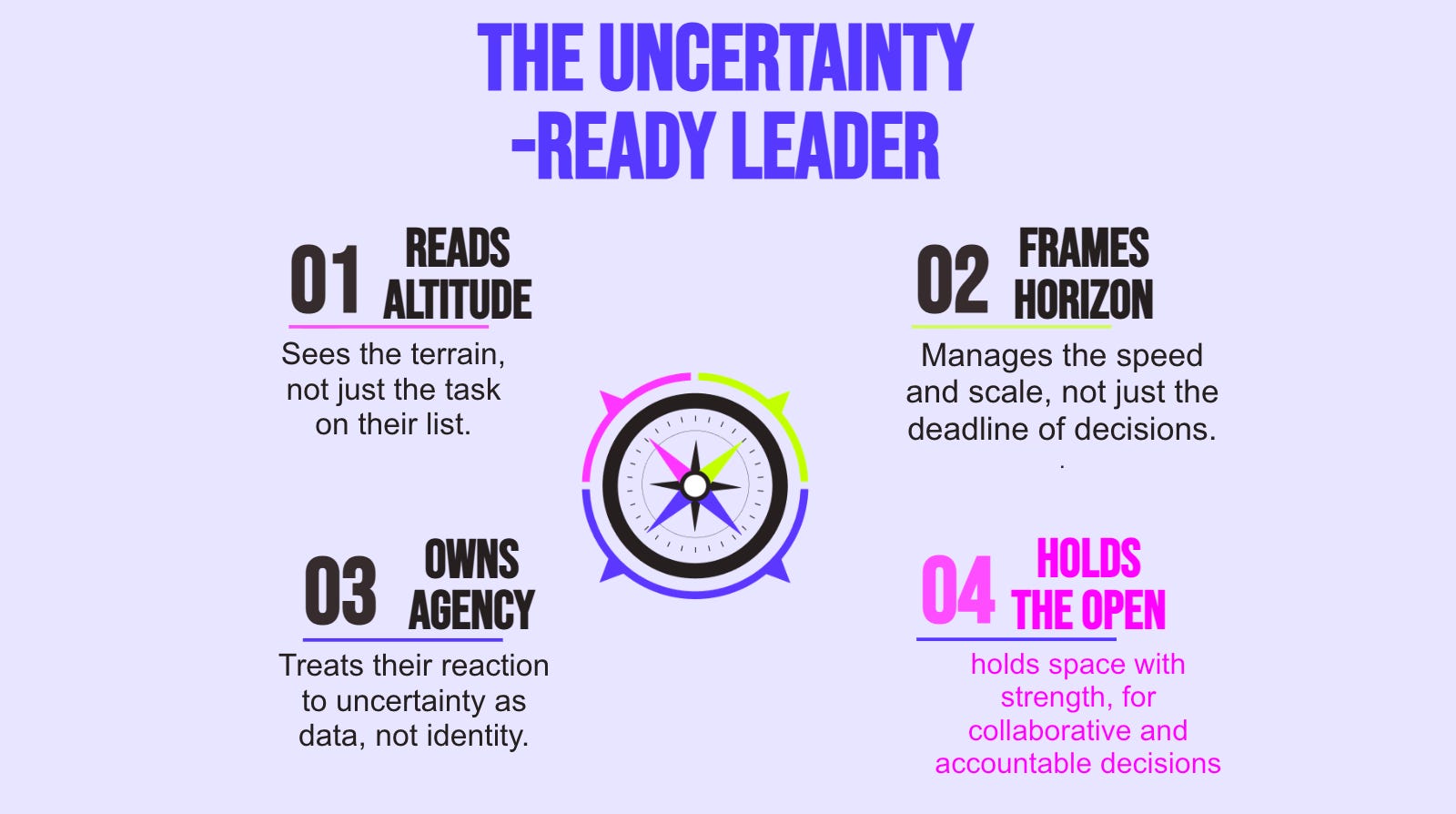
Either way, from the data-driven version of Wee Willie Winkie came a framework I call The Uncertainty Ready Leader. The insight at its heart is deceptively simple: under pressure, what separates the people who make better decisions? Three things.
Altitude: the techniques to rise above the immediate panic, prejudice and pressure.
Horizon: the skill to manage the speed of decisions, not just meet the deadline.
Agency: The ability to ground the decisions in accountability when the crunch comes.
All three can be trained. Yes, I’ve trademarked it. No, I’m not sorry.
Here’s what it could look like in politics (And keep going becuase there’s a link below to make it happen)
A cabinet minister who can’t tolerate not knowing long enough to find a real answer, so reaches for a bad one and calls it decisiveness, feels able to reach for a counter opinion to their own, which depolarises the debate.
An adviser who reads the room’s panic instead of the evidence, because silence feels more dangerous than being wrong, becomes the needed voice of the people.
A party that mistakes the speed of the news cycle for the speed of history, and optimises for tomorrow’s headline, not honesty, becomes a pledge we can trust.
We don’t have a stupid politics problem. We have an uncertainty-intolerant politics problem. And unlike stupidity, that’s fixable.
I know, because we’ve measurably moved it; in policing, energy, defence and health, where similar pressure is at play. The effects are real, and they last, not because we change the uncertainty, but because we change people's relationship to it.
Give us the UK’s politicians. Same deal. Average increase of about 30% more Uncertainty Tolerance.
So here’s the idea. The Ministry of Uncertainty Ready Leadership. A one-day, cross-party pop-up laboratory that appears, does the work, measures the impact, shares the tools, and disappears before anyone can form a steering committee.
Academic partners from UCL measure before and after. Results published openly. Everyone finds out which local MP improved the most.
Give us a few hundred politicians and a bloody big room and I will give you back people who are measurably more open-minded, less reactive, less prone to groupthink, and less likely to turn complexity into enemies.
Not suddenly free of ego, ambition, cowardice, or their incredible ability to avoid a direct answer. But measurably better at sitting with the unknown rather than grabbing the nearest bad answer.
This isn’t my bid for politics. God forbid. Although, for the record, Wes isn’t the only party-political figure who’s looked at me during a moment of institutional despair and briefly thought, “Maybe him?” here’s a funny story to reward anyone still reading…
Years ago, a senior Conservative adviser asked if I’d consider running for Mayor of London on a blue ticket. Then they found Boris Johnson. So I appear to be one of the few ideas British politics had immediately before deciding Boris was the safer option. A sentence no one should have to live with.
But no. This isn’t a bid for power. It’s a bid for usefulness.
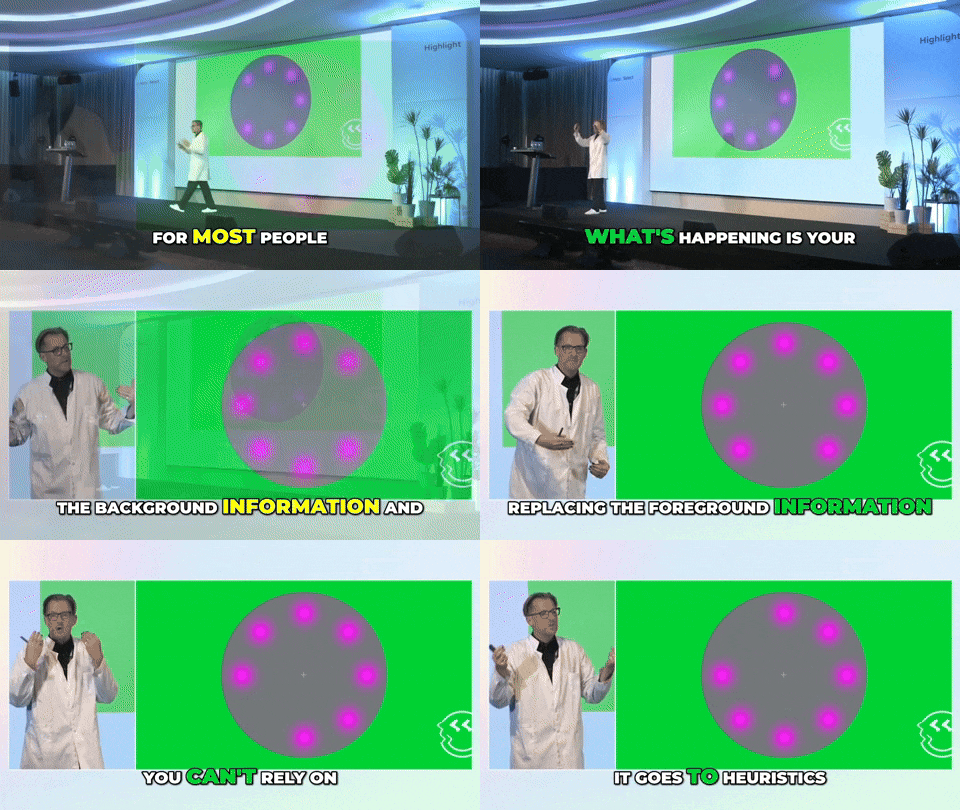
So Wes, Ed, Andy, Nige, Keir, Kemi, Carla, Daisy, and anyone OF YOU who thinks the next two years might require slightly more uncertainty-ready humans this is the offer. Give me a day, with as many of you as you can muster, and I’ll give you back people who are a little more ready for being unready, shall we do it??
In the process of writing this newsletter, I’ve convinced myself it’s a good idea, so begun an official petition to make UK politicians measurably more tolerant of uncertainty, it takes about a week to approve but add your name here and I’ll email you the moment it’s live to sign on the Parliament site. Takes 60 seconds.
Between my driver of increasing uncertainty tolerance in society, your driver of being able to do some good by the click of a button, and my CEO Giles’ driver to make his newly purchased product famous these intersecting ambitions might just do it.
Let’s build the Ministry of Uncertainty Ready Leadership. Put all of politics through it over a couple of days. Have a much better next two years. And shut it down before anyone suggests I become Minister of Uncertainty.
Actually — don’t tempt me.
Watch out, lads. Here come the dads.
One last thing, and it’s nothing to do with politics. This is your last chance to contribute to The Dadosphere, a side-experiment, exploring the best and worst advice men have ever received to build a generative father figure intelligence to provide better answers to the 80% of men who have questions they don’t know where to take, than the alternative fucko-off-osphere. Me, Hermes and Claude have have created seven science-informed questions that meet the unanswered question that most lead to men's mental health issues and need 17 more men for a baseline to provide a functioning mode So if your’re know a dad, are a man who ever had a dad, are a dad, or could one day be a dad, take two minutes and add yours: thedadosphere.com